What Is a Biohazard?
A biohazard is any biological material that poses a risk to human health, animal health, or the environment.
That includes bacteria, viruses, fungi, parasites, toxins produced by living organisms, and anything contaminated by them — blood, tissue, cultures, and used needles among them.
The term stretches from a discarded lancet in a dental office to a virus culture in a research laboratory. What connects them is the potential for infection or injury if the material is handled, stored, or disposed of incorrectly.
WHAT YOU NEED TO KNOW:
- What Counts as a Biohazard
- Biohazard, Biomedical, and Medical Waste: What’s the Difference
- Five Types of Biohazardous Materials
- The Biohazard Symbol
- Biohazard Containers and Segregation
- How Biohazardous Waste Is Handled in Canada
- Biohazard Levels in Canada
What Counts as a Biohazard
The defining feature of a biohazard is biological origin combined with the capacity to cause harm. For example, a chemical spill is hazardous, but it isn’t a biohazard. A used blood collection tube is.
Four conditions generally place a material in this category:
- Biological origin or contamination
- Capacity to cause infection or injury
- Risk of transmission to people, animals, or the environment
- Requirement for controlled handling and disposal
Not every material touched during patient care meets that bar. A gauze pad with a small amount of dried blood is usually general waste under most provincial rules, while a suction canister of blood is not.
Segregation depends on saturation, volume, and provincial definition, which is where most facilities lose money because biomedical waste treatment costs several times more per kilogram than general waste, and over-segregation is common.
Biohazard, Biomedical, and Medical Waste: What’s the Difference
These terms get used interchangeably, and in practice, they overlap heavily. The distinctions still matter for compliance.

- Biohazard describes the risk. It’s a hazard classification, not a waste stream. A live virus culture in a sealed laboratory freezer is a biohazard, but it isn’t waste yet.
- Biomedical waste is the regulated waste stream. In Canada, provincial regulations define what belongs in it, and the term applies specifically to waste generated by healthcare, veterinary, research, and testing facilities.
- Medical waste is the broadest term. It captures everything a healthcare facility discards, including general waste, recyclables, pharmaceutical waste, and biomedical waste.
Biomedical waste is classified as non-hazardous in most instances. It’s regulated, it requires specific treatment, and it carries infection risk, but it isn’t hazardous waste in the regulatory sense. Hazardous waste in a healthcare setting often means chemotherapy waste, radioactive waste, and certain pharmaceuticals, each governed by a separate framework.
For a full breakdown of provincial definitions, see what is considered biomedical waste in Canada.
Five Types of Biohazardous Materials
Most Canadian provinces build their regulations on the Canadian Council of Ministers of the Environment guidelines, which group biomedical waste into five categories. That document is national guidance rather than binding law, so each province writes its own definitions on top of it, and they don’t always match. Ontario recognizes nine categories under Guideline C-4 and Regulation 347, while Quebec and British Columbia define the stream differently again. Facilities are held to the provincial definition, not the national one.
 Human Anatomical Waste
Tissues, organs, and body parts. Teeth, hair, and nails are excluded in most provinces. Anatomical waste generally requires incineration and separate red containment.
 Animal Waste
Carcasses, tissues, organs, body parts, and bedding from animals infected with or exposed to a pathogen. Common in veterinary practices and research facilities.
 Microbiology Laboratory Waste
Cultures, stocks, specimens, live and attenuated vaccines, and any material that has come into contact with them. This is the category most likely to involve higher-risk pathogens.
 Human Blood and Body Fluid Waste
Liquid blood, blood products, and body fluids, along with materials saturated enough to release liquid if compressed. Dialysis waste, suction canisters, and specimen containers typically fall into this category.
 Waste Sharps
Needles, syringes with attached needles, scalpel blades, lancets, broken glass, and any item capable of puncturing skin. Sharps carry a dual hazard: physical injury and inoculation of whatever the sharp was contaminated with.
Cytotoxic waste sits alongside these categories rather than inside them. It requires dedicated containers and incineration-only treatment under provincial and federal rules.
The Biohazard Symbol
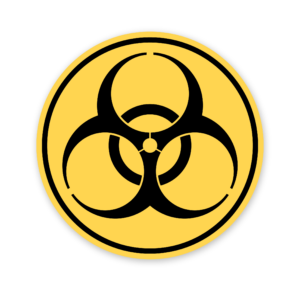
The biohazard symbol warns that biological material capable of causing infection or harm is present. The three-bladed trefoil is standardized internationally under ISO 7010 as symbol W009, and it means the same thing in every country that has adopted the standard.
It was also designed, deliberately, to mean nothing at all. In 1966, Charles Baldwin, an environmental health engineer at Dow Chemical, was asked to solve a problem: laboratories across North America were using homemade, inconsistent signage for dangerous biological material. Working with Robert Runkle at the National Cancer Institute, Baldwin’s team set out to find a mark with no existing associations, so nobody could confuse it with something familiar. They produced more than 40 candidate designs, narrowed them to six finalists, and tested those nationally alongside marks like the Shell and Texaco logos to measure recall. The trefoil won.
In Canadian healthcare settings, the symbol appears on:
- Biomedical waste containers and liners
- Sharps containers and cytotoxic containers
- Laboratory doors and containment zone entrances
- Refrigerators and freezers storing infectious material
- Transport packaging for infectious substances
A biohazard symbol on a container is a segregation instruction. It tells clinical staff what belongs inside and tells waste handlers downstream what treatment the contents require.
Biohazard Containers and Segregation
A biohazard container is any receptacle designed to contain biohazardous material safely from the point of generation through to treatment. Three requirements apply almost universally:
- Leak-resistant and rigid construction
- Puncture resistance for anything holding sharps
- Clear biohazard marking and colour coding
Colour coding varies by province, but the general convention is yellow for biomedical waste and red for anatomical waste bound for incineration. Cytotoxic waste uses dedicated containers, typically marked with the cytotoxic symbol rather than the standard trefoil.
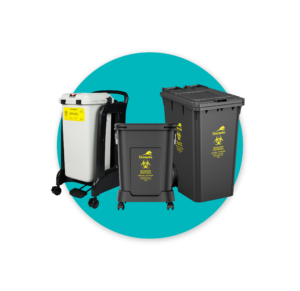
Sharps containers carry the strictest design requirements because a contaminated needle can deposit blood directly beneath the skin. The Canadian Centre for Occupational Health and Safety puts the risk of infection from a single needlestick at 6 to 30 percent for hepatitis B in an unvaccinated worker, roughly 1.8 percent for hepatitis C, and roughly 0.3 percent for HIV. Containers must sit within arm’s reach of the point of use, resist puncture, and lock permanently once full.
Daniels Health builds reusable biomedical waste containment systems that eliminate single-use bags and boxes entirely. Containers are collected, emptied, and returned through a robotic wash and decontamination process rather than sent to a landfill.
How Biohazardous Waste Is Handled in Canada
Under Canadian law, the generator is responsible for biomedical waste from the moment it’s created through to final treatment and disposal. That liability doesn’t transfer when a facility signs a contract with a waste provider. If waste is mishandled downstream, the generating facility remains accountable.
The chain typically runs like this:
- Segregation at Point of Generation
Staff place waste into the correct container as it’s produced. Everything downstream depends on it, and it’s the step most facilities get wrong. - Containment and Storage
Filled containers move to a secure, restricted-access storage area, and refrigeration requirements depend on the waste type and how long it sits. Ontario’s Guideline C-4 requires anatomical waste to be refrigerated at all times, while blood and microbiology waste only requires refrigeration past four days of storage. Transport compartments must stay at or below four degrees Celsius. Other provinces set their own thresholds, and sharps are typically exempt. - Transport
Biomedical waste travels as a Class 6.2 infectious substance under the Transportation of Dangerous Goods Regulations, with manifest documentation and licensed carriers. - Treatment
Most biomedical waste in Canada is treated by autoclave sterilization. Anatomical and cytotoxic waste must be incinerated. Some waste streams undergo chemical treatment depending on the type and provincial requirements. - Final Disposal
Once treated and rendered non-infectious, residual material is landfilled or otherwise disposed of according to local rules.
Daniels operates its own drivers, trucks, and treatment facilities across Canada, so the chain of custody is never broken and no third party ever handles the waste. For a closer look at each stage, read how biomedical waste is disposed of in Canada. Province-by-province requirements are covered on our standards and regulations page.
Biohazard Levels in Canada
Most search results on this topic use American terminology, BSL-1 through BSL-4. Canada runs a two-part framework instead.
Risk Groups classify the pathogen itself. Containment Levels classify the facility that handles it. The two are related but not interchangeable.
The handling and storing of Risk Group 2, 3, and 4 human pathogens and toxins is regulated by the Public Health Agency of Canada under the Human Pathogens and Toxins Act and its accompanying regulations. Requirements are set out in the Canadian Biosafety Standard, third edition, which came into effect on April 1, 2023.
- Risk Group 1: Low individual and community risk. Unlikely to cause disease in healthy people.
- Risk Group 2: Moderate individual risk, low community risk. Can cause disease, but effective treatment and preventive measures are usually available, and the risk of spread is limited. Most material a hospital or clinic generates falls here.
- Risk Group 3: High individual risk, low community risk. Causes serious disease, though treatment is usually available. Handled in Containment Level 3 laboratories.
- Risk Group 4: High individual and community risk. Causes life-threatening disease, transmits readily, and treatment is generally unavailable. Only a small number of Containment Level 4 facilities exist in Canada.
Waste handling rules escalate with the level. The 2021 edition of CSA Z317.10, the national standard for handling healthcare waste materials, addresses Category A waste and material contaminated with Risk Group 3 and 4 pathogens, which is transported under separate provisions of the Transportation of Dangerous Goods Regulations.

Taylor Maris
Frequently Asked Questions About Biohazard Waste in Canada
Let's Talk!
Your time is valuable, and we don’t want to play hard to get. You can either phone us directly on the details listed on our contact page, or feel free to fill out this short form and one of our team members will get back to you as quickly as possible.